Mark Lorenz Yamanaka, Philippine PRC Professional Aeronautical Engineer. dmmark.work@gmail.com, www.mlyamanaka.com
Four analyses with their numbers and how each was checked, three things built by hand, and two tools I made to learn with.
Analyses
Built by hand
Tools for the work
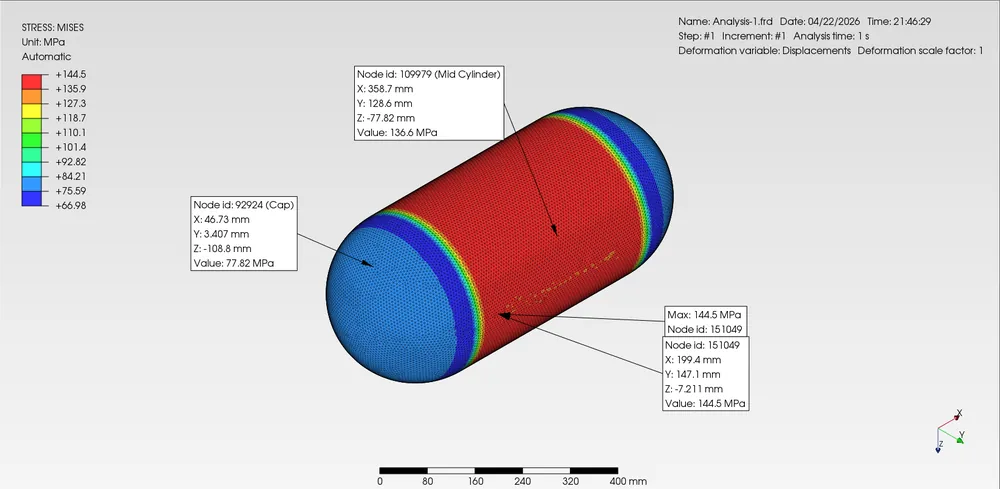
Stress governs at the chamber junction: a factor of safety of 7.12.
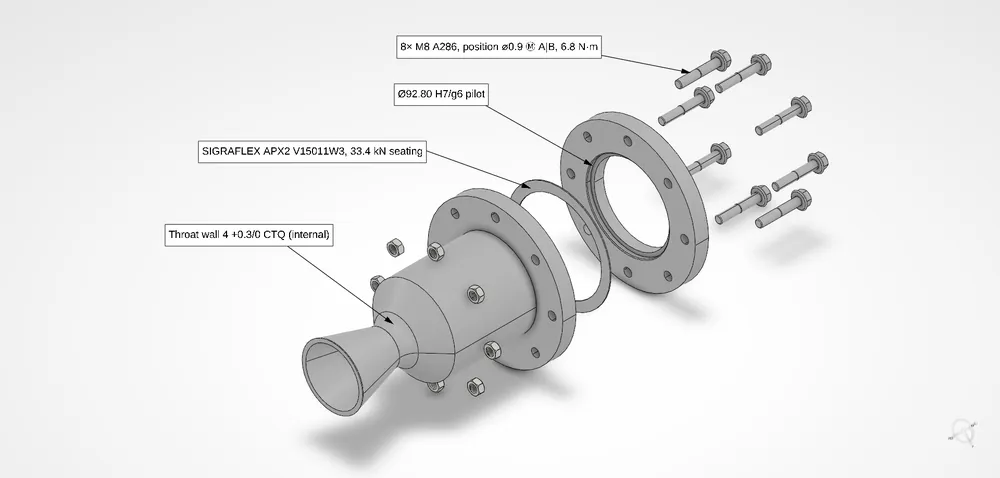
Propulsion, multiphysics and DFM
Full working on GitHub
Short of its 2.00 target at 1.91; 0.2 mm more wall clears it.
Pressure vessel and FEA
One weight baseline carried from the mission to the spar sizing.
Aircraft design, loads and structures
Static and fatigue checks are still open: no factor of safety yet.
Analysis in progress. Structures, dynamics and fatigue
Repository on release, once the analysis closes.
A foam-board UAV wired with the hardware its CAD specifies.
UAV and systems integration
PANO-VISTA is a tractor-configuration fixed-wing UAV, modeled part by part in one master assembly, then cut from foam board and wired up for real with brushless power, an eight-channel receiver, and four micro servos, one per surface. The hardware in the CAD is the hardware on the bench. Team project with four classmates; I designed the fuselage and procured the communication components.
A two-blade helicopter rotor drawn by hand, twisted from 78° to 24°.
Rotorcraft, drafting and CAD
A Ø 71.10 in two-blade helicopter rotor, drawn for the Basic Helicopter and Propeller Design course and traced in orthographic projection on tracing paper before it was ever parametric. The twist falls from 78° inboard to 24° at the tip because blade element theory asks for it, so that angle of attack stays roughly constant as local velocity climbs with radius.
Servo-driven slats and ailerons you can watch deploy.
Mechatronics, high-lift devices and Arduino
A sectioned wing built in cardboard and skinned in aluminum foil, mounted on its own stand so it can be demonstrated at eye level. Servos embedded in the section drive the ailerons and leading-edge slats from an Arduino Uno sketch, with a dedicated control interface on the base, so these are high-lift devices you can watch deploy instead of read about.
A hardware build, so there is no repository.
A practice app for the calls behind a stress check: commit a prediction, then watch the skin bay buckle.
In progress. Engineering judgement, elastic stability and React
Praxis drills the judgement around a stress check: what governs, how a result scales, and which line of a calculation went wrong. Its workbench shows one wing skin bay three ways: as part of the wing cover, as a simply supported plate and as a calculated response. Commit a prediction and the load ramps to ultimate; if the stress crosses σcr on the way, the plate buckles. A roadmap of 16 topics in four stages leads from the parts of the cover to a structural decision you can defend.
Three modes practise estimates (Daily Drill), experiments (the Exploration Lab) and calculation reviews (the Review Room), and answered questions return on a spaced-review schedule (FSRS). Each answer carries a confidence, scored by Brier loss. Every formula reproduces a published worked example from Bruhn or Megson, and every number in the twelve questions is checked against the engine. The answer keys and the roadmap still need an independent technical review.
Private while it is in progress. The pictures are from the running app.
A 3D simulator of detonation engines and mode switching, built from public sources to learn how they work: orbit an engine, cut it open and run it.
Detonation propulsion, interactive 3D and three.js
Yamanaka Works is where I build interactive models of engineering I want to understand. Study 01 covers four engines PD AeroSpace has described in public: its 2017 pulse engine, the 2022 rotating-detonation ring, the 2024 combined-cycle test rig and the mode-switching engine of patent application US 2025/0188893 A1. Each can be orbited, cut open and run, with the valves, the propellants, the detonation front and the exhaust moving in step. A guided demo walks through all four, and ten missions ask for a prediction before the controls are touched.
What is computed is kept apart from what is drawn. Jet and rocket thrust against altitude use the US Standard Atmosphere 1976, and the pulse engine's pressure trace comes from a one-dimensional solver; colours and part finishes are illustration. The engines, the patent application and the hardware are PD AeroSpace's. The models are my own reconstructions from public sources, and the project is personal, non-commercial and neither affiliated with nor endorsed by PD AeroSpace.
Open the simulator
I'm happy to walk through any of them end to end, including what changed between revisions.
Tsukuba, Ibaraki, Japan
Angeles, Pampanga, Philippines